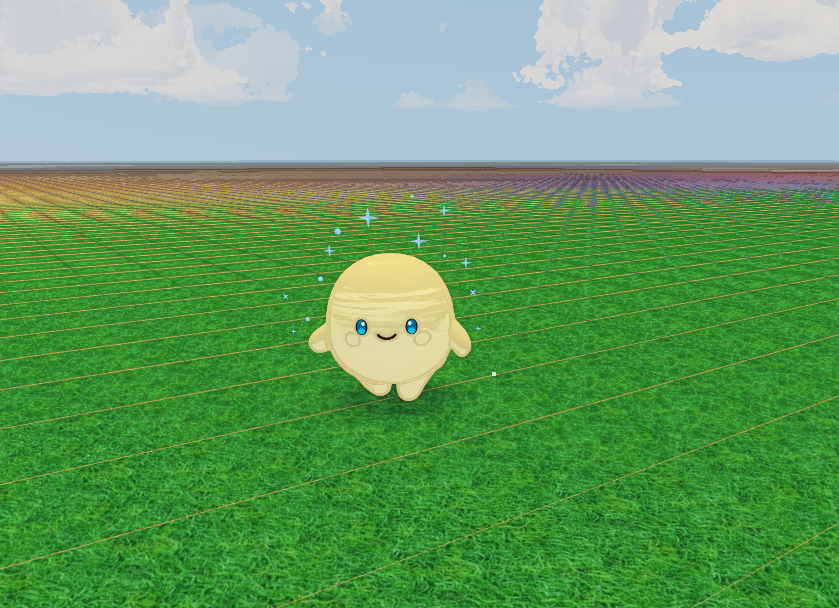


I wanted to write this dev log to explain how Luminids actually work under the hood.
A lot of recent development has focused on their “brains”. Not AI in the buzzword sense, but the structure that decides what a Luminid does, who they gravitate toward, and how they change over time.
Two Luminids can face the same task and respond differently - one heads straight in, another lingers, watches, and follows later.
The core idea
Every Luminid uses the same internal structure, expressed through three behavioural axes.
These axes shape how they approach the world and shift gradually over time.
| Axis | What It Controls | What You’ll Notice In Play |
|---|---|---|
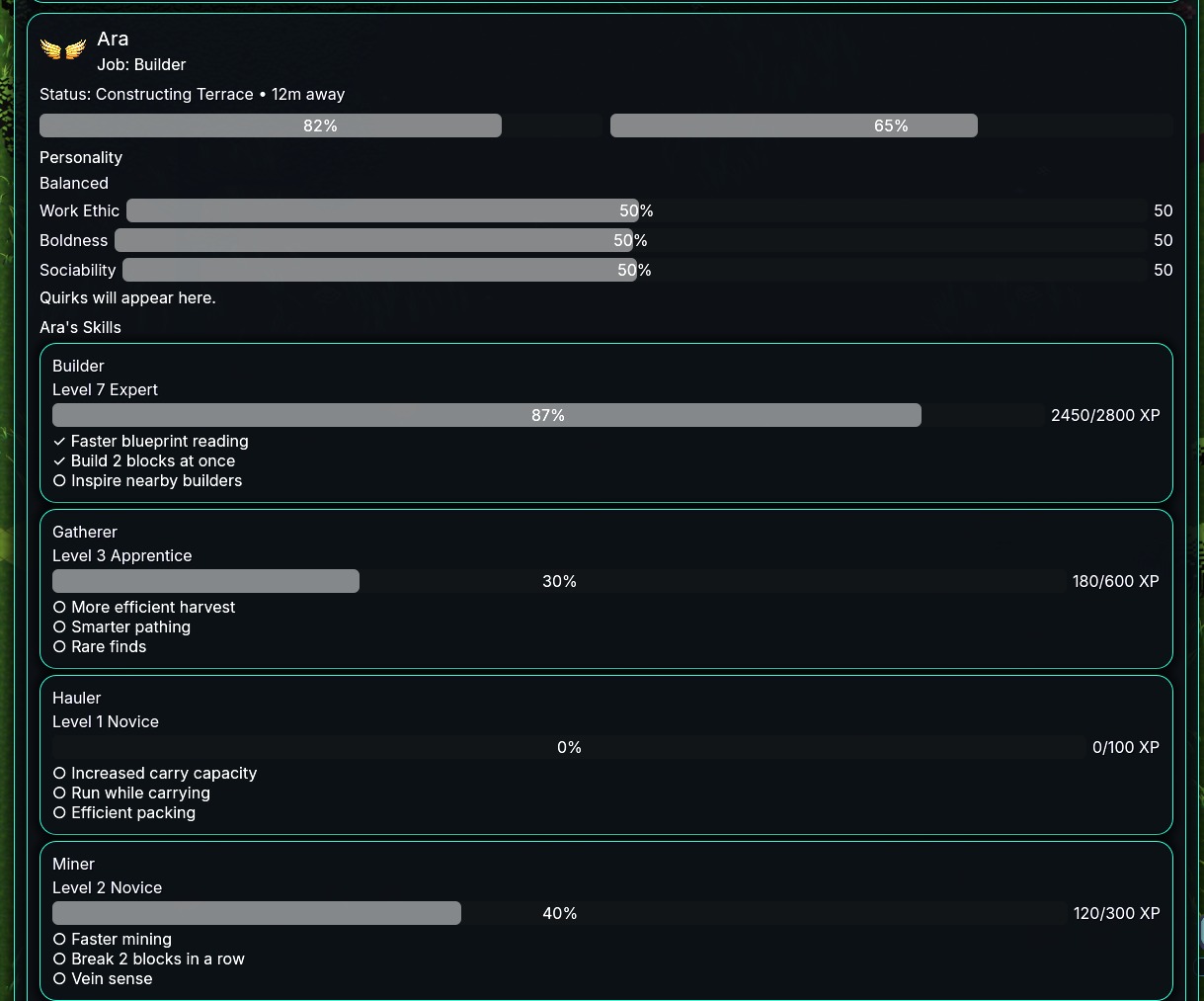
Work Drive W | How often a Luminid sticks with tasks and follows through | Some Luminids work steadily and stay focused. Others wander more, take breaks, or switch tasks often. |
Boldness B | How quickly a Luminid explores new spaces and reacts to uncertainty | Bolder Luminids explore new areas earlier and react calmly to change. Cautious ones stay closer to familiar spaces. |
Sociability S | How often a Luminid stays close to others while working | Social Luminids cluster, cooperate, and seek shared work. Less social ones operate more independently. |
Together, the three axes combine into a wide range of personalities, and the behaviour you see is just those mixes playing out over time.
In theory, there are infinite mixes. Here are a few examples:
- Work ↑ · Bold ↓ · Social ↓ Tends to work steadily alone and prefers familiar tasks.
- Work ↓ · Bold ↑ · Social ↑ Tends to explore, gather others, and shift tasks often.
- Work ↑ · Bold ↗ · Social ↑ Tends to coordinate with others and follow through on tasks.
- Work ↓ · Bold ↓ · Social ↑ Prefers safety in numbers, stays close to the group, learns by observing others.
- Work ↑ · Bold ↑ · Social ↓ Tends to push into new areas independently and stay focused.
These mixes influence how Luminids choose tasks, respond to change, and organise themselves, even when given the same job.
How Luminids Think

How decisions are made
In the moment, a Luminid weighs what needs doing nearby, how much energy they have, who is around them, and how safe it feels.
Those choices flow from the same model each time, which is why the patterns feel consistent without feeling scripted.
Quirks and tendencies
On top of the three axes, Luminids develop tendencies through repeated behaviour.
For example:
- A Luminid that spends a lot of time near water may start preferring it.
- One that works uninterrupted for long periods may become sensitive to disruption.
- One that often rests near others may become more socially oriented over time.
These tendencies are subtle. You discover them by watching patterns over time.
Relationships
Relationships are built the same way. Time spent together, shared work, resting nearby, or competing for the same task all add up.
Those feelings shift slowly, without instant flips.
When Luminids cooperate well, it’s usually because their axes and tendencies align naturally.
Why this structure matters
The goal is consistency.
If you watch a Luminid over time, their behaviour should make sense in hindsight. You should be able to say, “yeah, that tracks”.
I care much more about that feeling than about making them clever or unpredictable.
If something unexpected happens, I want it to feel like an emergent result of who that Luminid is, not a random roll.
What this means for players
You don’t manage these axes directly. You influence them by:
- shaping the world
- choosing where work happens
- deciding when to intervene and when to observe
Over time, the Luminids adapt to those conditions and to each other.
The end result I’m aiming for is a settlement where you recognise individuals by how they behave, not by labels or stats.
That’s the system I’m building toward, and this phase of development has been about getting that foundation solid.
What’s next
The next work is about tuning and expressing the model:
- better readability for player observation
- more nuanced tendencies
- richer social feedback loops
More to share soon.
Nick
 Get updates via Steam